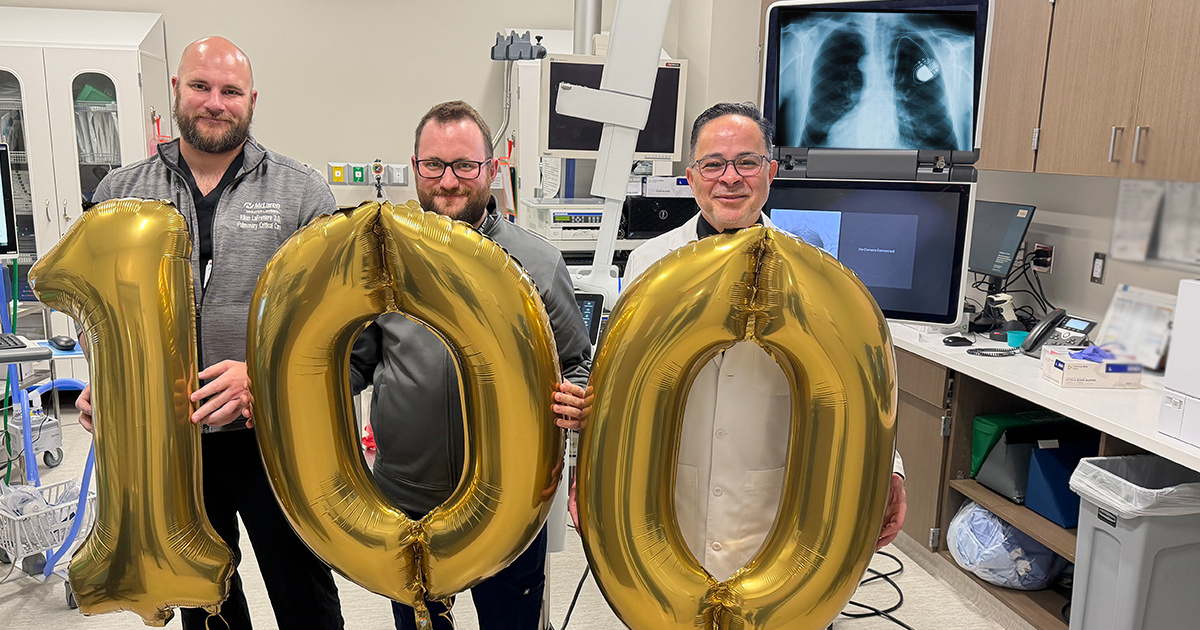
A year ago, McLaren Greater Lansing invested $700,000 to purchase an Ion Robotic Bronchoscopy, a platform for minimally invasive peripheral lung biopsy.
“Ion provides us with the ability to biopsy any nodule anywhere in the lung, and it allows us to also stage the patient at the same time with an endobronchial ultrasound (EBUS) procedure,” Dr. Daniel Kurtz, MD, FCCP, a pulmonologist who works at McLaren Greater Lansing.
The new system allows the doctor to do a biopsy of hard-to-reach lung nodules that may have previously been unable to be biopsied and diagnose/stage all in one outpatient procedure.
This month, the team at McLaren Greater Lansing just reached an amazing milestone of 100 Ion procedures completed.
“This milestone is worth celebrating because it means we helped people in our community get a diagnosis faster and hopefully get to cancer treatment sooner, which we know can save lives,” said Dr. Kurtz. “And, if there is no cancer found, we can offer our patients peace of mind.”
Why Early Screening Makes a Difference
“If we can catch lung cancer early, we can offer patients a cure,” said Dr. Kurtz. “Oftentimes, lung cancer is diagnosed in the later stages, but when we screen and offer early detection with biopsies, we have more options to treat the cancer.”
Lung cancer doesn’t always have symptoms; however, if you do experience symptoms, they could be:
- A persistent cough that won’t go away or gets worse.
- Chest pain.
- Coughing up blood.
- Feeling unusually tired or losing weight without trying.
- Frequent chest infections like bronchitis or pneumonia.
- Shortness of breath.
Screening can also include your home, not just your lungs. It’s important to test for radon in your home or rental. Because radon is tasteless, odorless, and colorless, you cannot tell if it is in your home without testing. Radon is the second leading cause of lung cancer, and the leading cause of lung cancer in non-smokers.
Who Should Consider Getting Screened?
Lung cancer screening isn’t for everyone, but it’s strongly recommended if you’re considered high risk. This includes:
- Adults aged 50 to 80.
- Anyone with a history of smoking a pack a day for 20 years (or two packs a day for 10 years).
- Current smokers or people who quit smoking within the last 15 years.
If you fall into any of these categories, talk to your doctor about getting a yearly low-dose CT scan to check for lung cancer.
What to Expect from a Lung Cancer Screening
Lung cancer screening requires a low-dose CT (LDCT) scan. This is a type of imaging test that uses significantly less radiation than a regular CT scan, yet still provides detailed pictures of your lungs. It’s more effective than a standard chest X-ray and can spot small nodules or abnormalities that might be signs of early-stage cancer.
Not all nodules found on a scan are cancerous—many are harmless. However, depending on the scan results, your doctor may recommend additional tests, such as a biopsy, to confirm the diagnosis.
To get a lung cancer screening, talk to your primary care provider. Looking for a new primary care provider? Check out our list of doctors accepting new patients.
To read more articles about health and wellness, click here.