Author: Leslie Toldo
During a routine visit, Jack Grossnickle’s dentist discovered a lump on the roof of Jack’s mouth. He referred Jack to an ear, nose, and throat (ENT) specialist.
“I also had a plugged-up nose, and it turned out that was because the lump my dentist found was pressing on a polyp in my nose,” said Jack. “The ENT said he wanted to do a biopsy to be on the safe side.”
Jack had sinonasal adenocarcinoma, which is a rare form of cancer that develops in the nasal cavity and sinuses.
“It hadn’t spread, and it was slow growing, so that helped me relax a little,” Jack said.
Jack, who lives in Grand Haven, saw an oncologist in Muskegon to determine his next steps.
“We talked about surgery, and that sounded really ugly,” Jack said. “Chemotherapy was not an option for me, but radiation was.”
Before deciding on his treatment path, Jack did a little research online and discovered a form of radiation called proton therapy. It isn’t offered where Jack lives, but he found that the largest proton therapy center in Michigan is in Flint.
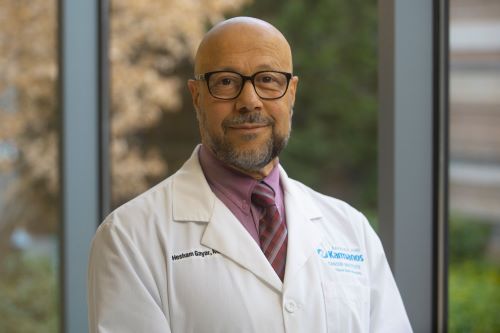
“I made an appointment to see Dr. Hesham Gayar at the McLaren Proton Therapy Center,” Jack said. “He is really easy to talk to. I don’t like doctors, but I like him.”
Dr. Gayar reviewed Jack’s MRI and noted he had a very large tumor that grew slowly- possibly over months or years. It had done so silently, without causing symptoms other than the mass the dentist discovered on the roof of Jack’s mouth and the nasal blockage Jack said he experienced.
“The tumor went through the paranasal sinuses and the space behind the nose and his left maxillary sinus up next to his left eye, into the base of skull into the cranial cavity next to the brain,” said Dr. Gayar. “Such a large tumor could not be removed surgically and could not be treated with conventional radiation as it would be too risky. Only with proton therapy can such a tumor be treated to a curative radiation dose without significant damage to normal structure including critical cranial nerves, the eyes and the brain. “
During traditional radiation therapy, photons (X-rays) travel to the tumor, deliver radiation, then continue through the body, leaving an exit dose behind. Protons stop at the tumor, leaving no exit dose, which means there is far less risk of damage to healthy tissue surrounding the tumor. For patients, that means less risk of side effects during and even long after treatment
After talking with Dr. Gayar, Jack was convinced proton therapy was the right treatment for him, but there was one small problem.
“Flint, where the McLaren Proton Therapy Center is located, is more than two hours away from where I live,” said Jack.
Fortunately for him, the Hospitality House at McLaren Flint is right next door to the Proton Therapy Center. The House offers low- or no-cost accommodation for out-of-town patients and their loved ones.
“It was so convenient, and the facilities are excellent,” Jack said. “The people who run it are wonderful, and I made a lot of great friends with other patients while I was there.”
Jack went through eight weeks of treatments and discovered why other patients he read about online were so happy with proton therapy.
“First of all, the radiation techs there were great, and so friendly,” said Jack. “I really didn’t feel anything during treatments. My face got a little red, and I had a sore throat afterwards, but it wasn't much trouble at all. I feel good. I felt good through the whole thing.”
Today, Jack shares his story to offer hope to others facing cancer and to encourage them to be their own health advocates.
“I think people should research treatments,” Jack said. “And I would definitely recommend the McLaren Proton Therapy Center.”
If you are interested in learning more about proton therapy or getting a consultation at the McLaren Proton Therapy Center, visit mclaren.org/protontherapy or call (855) 697-7686.