Author: Leslie Toldo
After a suspicious area showed up on Cindy Gancarz’s routine mammogram, she was called back in for a breast ultrasound.
“They seemed to be okay with the results, but they did want to see me again in six months,” Cindy said. “When I went to the McLaren Imaging Center in Flint for my next screening, the doctor decided to do a breast MRI to investigate further.”
Breast MRI can often detect smaller masses that mammograms and ultrasounds may miss. In Cindy’s case, that is exactly what happened.
“I was very upset and anxious,” Cindy said. “But when the doctor called with my results, she reassured me that the mass they found was very small. And they still did not know whether it was cancerous.”
A biopsy revealed what Cindy had feared all along- the small mass in her left breast was cancerous.
“You take deep breaths and settle in and start doing what the doctors tell you,” Cindy said.
The first stop on Cindy’s care journey was to see Karmanos Cancer Institute at McLaren Flint breast surgeon Dr. Ashley Richardson.
“I was crying because she made me feel like I would be okay,” Cindy said.
Dr. Richardson performed a lumpectomy and removed a few lymph nodes. The procedure was a success, and the cancer had not spread. While Cindy did not need chemotherapy, she still faced radiation.
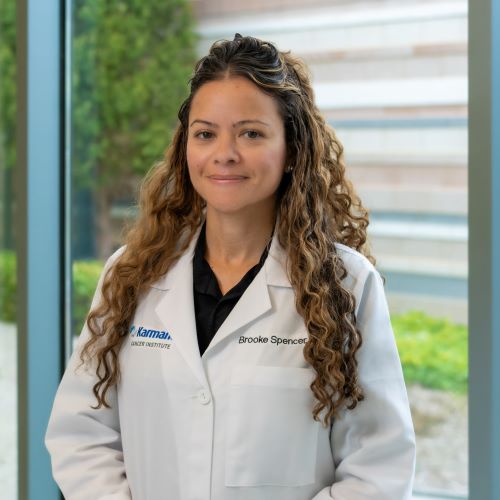
“The anxiety started to creep in again,” Cindy said. “Dr. Brooke Spencer, my radiation oncologist, explained my options, which included taking a hormone-blocking drug and having either traditional radiation therapy or trying a different version at the McLaren Proton Therapy Center. I wasn’t sure what I should do.”
Cindy wanted help making decisions about her next steps, so she spoke to her niece, who works at the McLaren Flint Imaging Center. Cindy shared what Dr. Spencer told her about having proton therapy versus traditional radiation treatment.
“My niece thought proton therapy sounded like the better option because there was less risk of damaging organs near my breast during treatment, and less risk of complications later on,” Cindy said.
Photons used in traditional radiation therapy deliver radiation to the tumor, then continue through the body, leaving behind an exit dose that can affect healthy organs and tissue surrounding the tumor. Protons deliver the radiation to the tumor and stop there, leaving no exit dose behind.
“This is important, particularly with left-sided breast cancer, because the tumor is typically closer to the heart,” said Dr. Spencer. “Using proton for left-sided breast cancers usually allows for lower doses to the heart, which may be associated with less risk of long-term side effects, like heart issues, later on.”
With a nudge from her niece, Cindy became the 1,500th patient at the McLaren Proton Therapy Center. She feels good about her choice.
“I am so glad I did this. The staff there was wonderful- kind and thoughtful,” Cindy said. “From my very first treatment, they worked with me and my anxiety and made me feel comfortable.”
Cindy shares her story not only to educate others about proton therapy but also to give hope to other cancer patients who may be overwhelmed by anxiety.
“Get comfort from the people around you,” Cindy said. “And put your mind somewhere else. I would think about better places. I would talk to Him, upstairs, and gain comfort.”
To learn more about proton therapy and find out whether you or a loved one might be a candidate, visit mclaren.org/protontherapy.